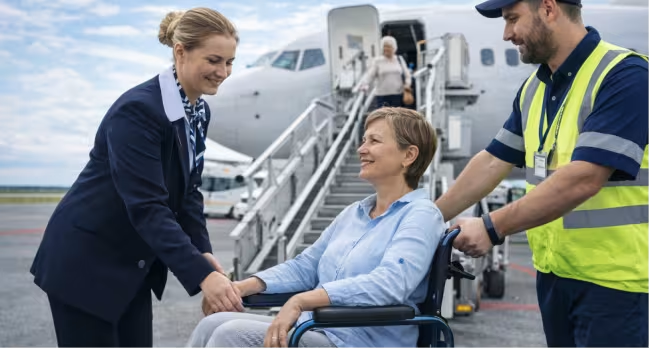

SERVICES FOR PASSENGERS WITH REDUCED MOBILITY AND SPECIAL CATEGORIES OF PASSENGERS
To ensure quality service and safety for all passengers, including those with disabilities and special needs, it is essential to understand their needs, rights, and the procedures for providing assistance at the airport.
This training will help you acquire theoretical knowledge and practical skills for appropriate, safe, and respectful treatment of passengers with reduced mobility and special category passengers, in accordance with international and European standards.
What will you know and be able to do after completing the training?
- Understand the legal framework and international standards for servicing PRM (Passengers with Reduced Mobility);
- Understand the challenges and needs of people with various types of disabilities;
- Apply the correct approach and communication for each type of passenger;
- Ensure safe movement and boarding;
- Handle wheelchairs and other assistive devices carefully;
- Identify and work with assistance animals;
- Apply the procedures for pre-notification (PAL, CAL, PSM) and coordination between departments;
- Adhere to the principles of accessibility, independence, and dignity of each passenger.
What will you receive?
Real situations. Practical examples. Test preparation.
The training includes a lecture and practical parts, exercises, and role-playing games. The final test assesses the acquired knowledge, with a requirement for a minimum pass rate of 80% success.
⚠️Upon successful completion of the course, you will receive a certificate valid for 36 months, with mandatory refreshment of knowledge every three years.
Who is this training for?
- Employees providing or aiding assistance to passengers with reduced mobility (PRM);
- Ground handling staff;
- Employees from departments involved in receiving, accommodating, and transporting passengers with disabilities;
- Individuals who directly communicate with passengers or provide assistance during their stay at the airport.
What will you learn?
- Regulations and international standards (ICAO Annex 9, Regulation No.1107/2006, ECAC Doc 30, US Air Carrier Access Act);
- Understanding different types of disabilities - motor, visual, auditory, cognitive, mental, and invisible;
- Ethical standards and proper language when working with people with disabilities;
- Responsibilities of the airport operator and organization of the PRM service;
- Communication and interaction with passengers needing assistance;
- Procedures for pre-notification and coordination between departments (PAL, CAL, PSM);
- Seating of PRM onboard and safety measures;
- Assistance dogs and their handling;
- Practical guidelines for creating an accessible and safe airport environment.
Duration:
- Initial: 8 training hours
- Recurrent: 4 training hours
Instructors
The course is led by certified aviation instructors with real experience in serving passengers with reduced mobility and working on implementing international standards for accessibility and safety. They will introduce you to the best practices and approaches to ensure comfort and respect for each passenger.