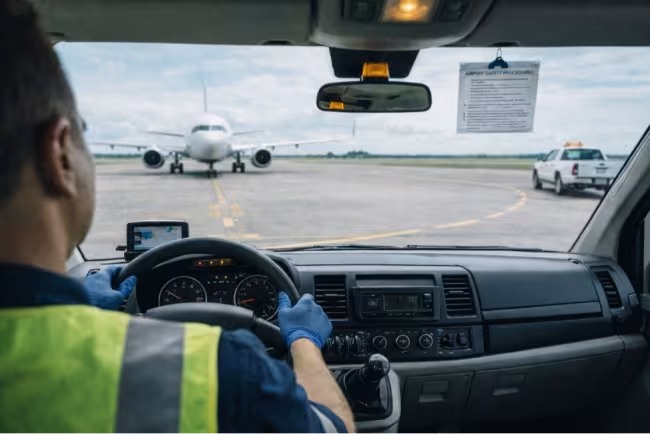

AIRSIDE SAFETY DRIVING
To be successful in your work as an employee/worker operating in the airport working area, it is necessary to possess knowledge, practical skills, and understanding of safe movement and work in the apron zone.
This course will help you realize your responsibilities in managing a vehicle in the airfield and prepare you to respond adequately in various operational and emergency situations.
What will you know and be able to do after completing the training?
- Understand the requirements of national and airport legislation for movement in the airfield;
- Apply the rules and procedures for safe movement on the apron and adjacent areas;
- Recognize the markings, signs, and lights used in the airport environment;
- Use radio communication and light signals according to established procedures;
- Identify potential hazards and apply preventive measures;
- Respond correctly in emergency situations and in low visibility conditions;
- Understand the influence of the human factor and avoid making mistakes;
- Drive a vehicle in the airfield in accordance with all aviation safety standards.
What will you receive?
Preparation! Practice! Real examples!
The training includes a theoretical and practical part with exercises in a real airport environment. The final test checks the acquired knowledge and skills, requiring a minimum 80% success rate to pass.
⚠️After successfully completing the course, you will receive a Certificate for Driving in the Airfield valid for 36 months, with mandatory knowledge refreshment every 3 years.
Who is this training for?
- Drivers of vehicles operating in the airport working area;
- Ground service personnel, operators, technicians, and employees of external organizations working on the apron;
- All individuals operating or moving independently in the airfield zone.
What will you learn?
- National and airport regulations for movement in the airfield;
- Requirements of the Civil Aviation Administration, airport operator, and ATS;
- Airport markings, signs, and light signals;
- Rules for movement on the apron and around aircraft;
- Personal responsibilities and safe behavior at work;
- Use of radio communication and correct call signs;
- Procedures in emergency situations and low visibility conditions;
- Basics of the human factor in the context of safe management;
- Practical exercises on movement in the airfield.
Duration:
- Initial: up to 6 training hours/ three hours theory + practice
- Recurrent: 3 training hours
Instructors
The training is led by aviation safety inspectors with extensive practical experience in managing ground operations and coordinating activities in the airfield zone. They will help you master all key principles and best practices for safe movement and work in this specialized environment.